SpaceX designs, manufactures and launches advanced rockets and spacecraft. The company was founded in 2002 to revolutionize space technology, with the ultimate goal of enabling people to live on other planets.
-
2010
DECEMBER 2010
On December 8, 2010, Dragon became the first privately developed spacecraft in history to re-enter from low-Earth orbit. -
2012
May 2012
Dragon becomes the first private spacecraft in history to visit the space station. -
2013
DECEMBER 2013
Falcon 9 reaches Geosynchronous Transfer Orbit (GTO)
-
2014
APRIL 2014
Falcon 9 first stage successfully lands in Atlantic Ocean.
SEPTEMBER 2014
NASA awards SpaceX $2.6B contract to fly American astronauts.
-
2015
DECEMBER 2015
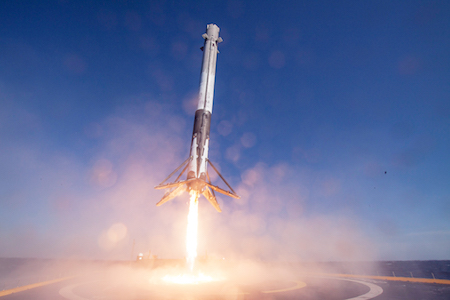
On December 21, 2015, the Falcon 9 rocket delivered 11 communications satellites to orbit, and the first-stage returned and landed at Landing Zone 1 -– the first-ever orbital class rocket landing.
-
2016
APRIL 2016
On April 8, 2016, the Falcon 9 rocket launched the Dragon spacecraft to the International Space Station, and the first-stage returned and landed on the "Of Course I Still Love You" droneship.
-
Future
Currently under development is the Falcon Heavy, which will be the world’s most powerful rocket. All the while, SpaceX continues to work toward one of its key goals—developing reusable rockets, a feat that will transform space exploration by delivering highly reliable vehicles at radically reduced costs.
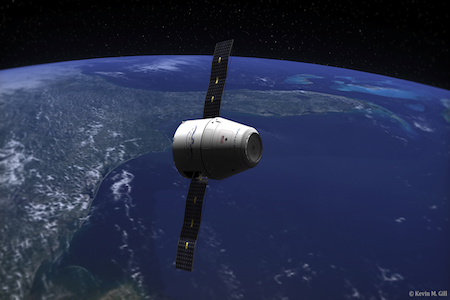
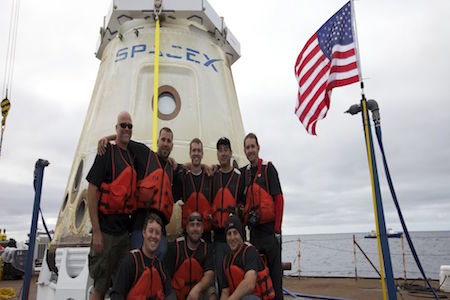
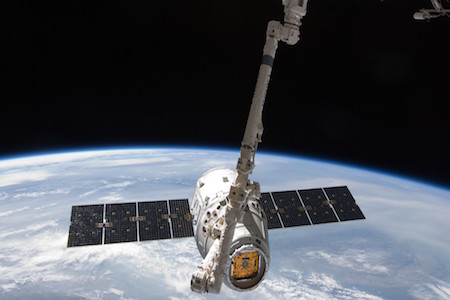
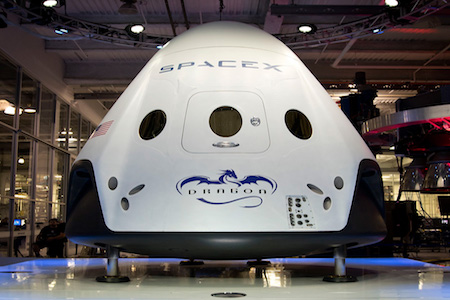
SpaceX has gained worldwide attention for a series of historic milestones. It is the only private company ever to return a spacecraft from low-Earth orbit, which it first accomplished in December 2010. The company made history again in May 2012 when its Dragon spacecraft attached to the International Space Station, exchanged cargo payloads, and returned safely to Earth — a technically challenging feat previously accomplished only by governments. Since then Dragon has delivered cargo to and from the space station multiple times, providing regular cargo resupply missions for NASA.
PAYLOAD
Falcon 9 delivers payloads to space aboard the Dragon spacecraft or inside a composite fairing.
DRAGON SPACECRAFT
Dragon carries cargo in the spacecraft’s pressurized capsule and unpressurized trunk, which can also accommodate secondary payloads. In the future, Dragon will carry astronauts in the pressurized capsule as well.

Dragon Spacecraft & Trunk 8.1m (26.6 ft) height, 3.7m (12 ft) diameter
COMPOSITE FAIRING
The payload fairing is for the delivery of satellites to destinations in low Earth orbit (LEO), geosynchronous transfer orbit (GTO) and beyond.
INTERSTAGE
The interstage is a composite structure that connects the first and second stages and holds the release and separation system. Falcon 9 uses an all-pneumatic stage separation system for low-shock, highly reliable separation that can be tested on the ground, unlike pyrotechnic systems used on most launch vehicles.

Composite Fairing 13.1m (43 ft) height, 5.2m (17.1 ft) diameter
FIRST STAGE
Falcon 9’s first stage incorporates nine Merlin engines and aluminum-lithium alloy tanks containing liquid oxygen and rocket-grade kerosene (RP-1) propellant. After ignition, a hold-before-release system ensures that all engines are verified for full-thrust performance before the rocket is released for flight. Then, with thrust greater than five 747s at full power, the Merlin engines launch the rocket to space. Unlike airplanes, a rocket's thrust actually increases with altitude; Falcon 9 generates more than 1.7 million pounds of thrust at sea level but gets up to over 1.8 million pounds of thrust in the vacuum of space. The first stage engines are gradually throttled near the end of first-stage flight to limit launch vehicle acceleration as the rocket’s mass decreases with the burning of fuel.
ENGINES
9
BURN TIME
162sec
THRUST AT SEA LEVEL
7,607 kN
THRUST IN VACUUM
8,227 kN
SECOND STAGE
The second stage, powered by a single Merlin vacuum engine, delivers Falcon 9’s payload to the desired orbit. The second stage engine ignites a few seconds after stage separation, and can be restarted multiple times to place multiple payloads into different orbits. For maximum reliability, the second stage has redundant igniter systems. Like the first stage, the second stage is made from a high-strength aluminum-lithium alloy.
ENGINE
1
BURN TIME
397sec
THRUST
934 kN
NINE MERLIN ENGINES
With its nine first-stage Merlin engines clustered together, Falcon 9 can sustain up to two engine shutdowns during flight and still successfully complete its mission. Falcon 9 is the only launch vehicle in its class with this key reliability feature.
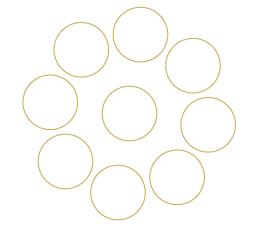
The nine Merlin engine Octaweb
